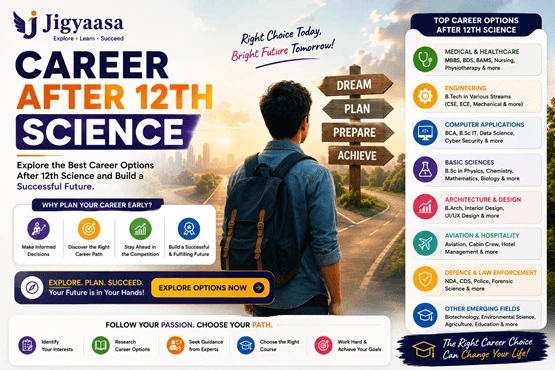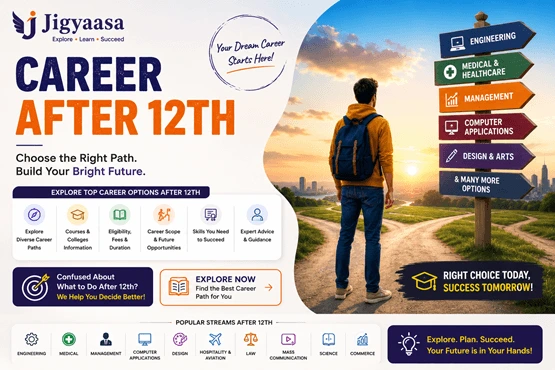
Students who are looking for a career after 12th need to think about their career interests first, and then the availability of jobs in that domain. The recent National Education Policy (NEP) give students immense freedom to make their own subject choices and special career paths that combine different subjects and skills.
To be successful in professional life, students must consider these three points:
- Their personal strengths (Personal Aptitude): what are the natural skills they are good at, such as reading, writing and solving logical/mathematical problems? Or they have creative skills in communication, art, and acting, etc.
- Personal Interests: What do the students really care about? The subjects, jobs or activities.
- Market Demand: What is the current market demand? Which technology or sector is growing in the next five years, and what are the new jobs and who is hiring them
Choosing the right career after 12th Science is one of the most important decisions in the academic journey. Whether students studied PCM (Physics, Chemistry, Mathematics) or PCB (Physics, Chemistry, Biology), the science stream offers a wide range of opportunities in engineering, medicine, technology, healthcare and research.
The current market of Artificial Intelligence and Data Science is growing rapidly and opening the door to good jobs with decent salary packages.
Understanding the interests, strengths, and career goals can help them to select the right course for a successful future. This blog explores the best career options after 12th science, along with popular courses and growing industries.
Students can take guidance and current job market insights to make better career decisions.
Understanding the core operational difference between these two tracks helps students to streamline their career decisions.
PCM vs. PCB Career Focus:
| Feature | PCM (Physics, Chemistry, Mathematics) | PCB (Physics, Chemistry, Biology) |
| Primary Focus | Mathematics, Technology, Engineering, coding and problem solving | Biology, healthcare, Chemistry |
| Skills Required | Analytical thinking, logical reasoning, programming and design | Scientific observation, critical thinking, communication and clinical knowledge |
| Typical Course Duration | 3 to 4 years for an undergraduate programme | 4 to 5.5 years for medical and healthcare programmes, depending on the course. |
| Career Options | Software Engineer, Data Scientist, Civil Engineer, Architect and AI Engineer | Doctor, Dentist, Pharmacist, Physiotherapist, Medical Researcher and Healthcare Manager |
Choosing the right career after 12th requires understanding the interests, strengths and long-term goals. A well-planned decision based on aptitude and industry demand leads to a rewarding career in the future.
- Identify interests and strongest subjects.
- Take an aptitude or psychometric test.
- Match the skills with suitable career options.
- Research high-demand industries and future job trends.
- Compare career growth, salary and job opportunities.
- Seek guidance from professionals and career counsellors.
- Choose a path that aligns with the goals and interests.
Stream-Wise Pathways To Choose The Perfect Career After 12th
Selecting the appropriate undergraduate degree requires an accurate understanding of the stream’s specific modules. The job market always rewards specialised skills, interdisciplinary flexibility, and a strategic professional degree.
Complete guide to career after 12th Science
The science streams build strong analytical capabilities, preparing students for highly technical and quantitative industries.
- The PCM Stream (Physics, Chemistry, Mathematics)
- Engineering and Technology: The traditional B.Tech and B.E degree courses are good and offer a high-growth career track in Robotics, Cybersecurity and Aerospace Engineering.Architectural and Design: A5-year B.Arch degree combines structural engineering concepts with spatial planning and urban design.
- Data Science and Analytics: Specialised B.Sc or B.tech tracks in Data Science prepare students for core Machine Learning Operations.
- Institute Diplomas: Short-term technical diplomas from recognised institutes provide direct entry into network administration, UI/UX execution and animations.
- The PCB Stream (Physics, Chemistry, Biology)
- Clinical Medicine: Entering professionals track like MBBS, BDS or AYUSH systems via national entrance exams.
- Pharmacology and Biotech: B.Pharma, D.Pharma and B.Sc. Biotechnology programs bridge laboratory and discovery with pharmaceutical manufacturing.
- Allied Health Science: Fast-growing diagnostic and clinical support roles including physiotherapy (BPT), Optometry and Medical Lab Technology (BMLT).
- High Salary Courses After 12th Science
- Artificial Intelligence and Machine Learning (AI-ML) Engineering: Develop intelligent software and AI applications for various industries such as healthcare, finance and technology.
- Data Scientist: Analyse data to help businesses make better decisions using statistics, machine learning and predictive models.
- Commercial Pilot: Fly passenger or cargo aircraft after completing aviation training and obtaining a commercial pilot licence.
- Specialist Doctor/ Surgeon: Diagnose and treat patients in the specialised medical field after completing advanced medical education and training.
Career After 12th Commerce
The commerce stream focuses on corporate finance, asset valuation, market financial economics, and business operations.
- Chartered Accountancy (CA): ICAI manages a professional credential that focuses on auditing, taxation and corporate governance.
- Chartered Financial Analyst (CFA): A professional course that prepares students for investment management, finance and portfolio analysis careers.
- Business Administration (BBA/BMS): Undergraduate programmes which build skills in business management, marketing, finance and leadership.
- Banking and Corporate Finance: Courses that prepare students for banking, financial services, investment, accounting and corporate finance careers.
- Economics and Actuarial Science: Study economic trends, financial planning, statistics and risk analysis for careers in finance and insurance.
Best Career Options After 12th Commerce with a High Salary
- Investment Banker: Professionals help companies in raising money, managing investments and handling business mergers and acquisitions.
- Actuary: Professionals use mathematics and statistics to assess financial risks for insurance companies and businesses.
- Management Consultant: Professionals organise and improve business strategies, operations and overall performance.
- Corporate Lawyer: Serve legal advice to companies on business laws, contracts and compliance in corporate matters.
Creative and Analytical Pathways: Career After 12th Arts
The stream prepares students for roles in public policy, strategic communication, human behaviour and creative execution.
- Journalism and Mass Media (BJMC): Learn news, reporting, digital media, video editing and public relations.
- Professional Design (B.Des): Build skills in UX/UI design, graphics design, interior and product design.
- Public Administration and Policy: The career path studies how the government works, laws and public policy creation.
- Corporate Communications: Students learn to manage a company’s public image, handle media, and communicate with employees or customers.
- Civil Services Preparation: Study subjects such as History, Geography and Sociology to build a strong foundation for UPSC and other government exams.
Tricks to Choose an Art-Based Career for Career Satisfaction
- Choose career-focused skills: Learn skills that companies need, such as UX/UI design, digital design and content creation.
- Learn Basic Data Skills: Combine the degree with skills in data analysis, market research or digital tools, which improves job opportunities.
- Create a strong portfolio: Show the best projects, designs, articles or case studies to improve your skills over the marks.
Healthcare Focus: Career After 12th Biology
The stream offers many clinical and non-clinical avenues. The broad categories include:
- Medical Entry (MBBS): The stream leads to a career path to become a licensed physician. Students need to clear a national entrance exam (NEET) to become a doctor.
- Bachelor of Dental Surgery (BDS): A specialised 5-year professional program focus entirely on oral health and craniofacial surgery.
- Alternative Medicine (BAMS/ BHMS): Professional institutional training in Indian Ayurvedic or Homoeopathic medicine.
- B.Sc Biotechnology/ Microbiology: Trains in advanced laboratory tracks focusing on vaccine development, genetic sequencing and agricultural enhancement.
- Allied Health Options: High-employment tracks in occupational therapy, Speech Therapy and Critical Care Technology that do not require an MBBS degree.
Best Career Options After 12th Non-Medical
Students pursuing a non-medical path without following a traditional engineering path can benefit them in skil-first framework.
- Vocational Diplomats (B.Voc): Good to learn job-ready skills in retail, logistics, hospitality and other industries.
- IT and Tech Support Jobs: Build a career in technical support, cloud services or database management through certifications.
- Diploma and Engineering Hybrids: A lateral entry path to complete a 3-year polytechnic diploma after school. After completing this, students can take admission directly into the second year of a B.Tech degree.
PCM vs PCB: Which Career Path is Right for You?
Choosing between a mathematics and biology stream path defines different day-to-day operations.
| Comparison Factors | PCM Track (Engineering/ Tech) | PCB Track (Medical/ Paramedical) |
| Core Functions | Writing Code, designing structures, debugging systems and optimising code | Diagnose, analyse, and manage overall patient care, including lab sample analysis |
| Academic Velocity | 4 years BTtech degree is the core academic requirement for corporate hiring | The graduation degree (MBBS) and specialisation require a PG degree in (MD/MS) |
| Work Environment | Corporate tech offices, remote software startups, or industrial engineering facilities | Hospitals, diagnostic centres or community health centres. |
| Risk Factors | Vulnerable to rapid technological changes, requiring constant upskilling in software | Demands high emotional engagement, long shifts and emergency cases. |
High Salary and In-demand Career Options after 12th
When students finish school, they want to choose a stream to follow a career path full of opportunities. For this, they should pick a skill-first field. Companies are looking for professionals with hands-on skill perfection.
By considering this, students must choose a career path and then a university that can accomplish both of these. An institute with good return on investment pays back the investment as early as possible, with fast career growth.
The idea is to find a job where companies need people with technical skills, with data-driven strategies and where the technical skills are very important. This will lead to getting a good job with a good ROI.
Best High Salary Courses After 12th Science
The science stream offers some of the highest-paying entry-level technical roles globally.
- B.Tech in Computer Science/ AI and Machine Learning: A 4-year degree focusing on generative AI, neural networks, and scalable software systems.
- B.Sc / B.Tech in Data Science and Quantitative Finance: Combines advanced mathematics, statistical modelling, and computational coding to predict market trends and corporate data facts.
- Bachelor of Architecture (B.Arch): A 5-year professional program leads to the real estate, corporate infrastructure and urban design sectors.
- Bachelor of Pharmacy (B.Pharm) +MBA Pharma: The dual combination leads to a domain-skilled corporate sector, where students can work in corporate pharmaceutical management, clinical research strategies, and for global healthcare supply lines.
- Commercial Pilot License (CPL) training: The career path leads to the international aviation industry, where starting salary packages are high.
Best Career Options After 12th Across Streams
It is not a fact that only science students earn a high package. Each field demands skills and perfection, which lead them to their career peak with a high salary package.
- Arts
- Commerce
- Science
- Humanities
| Stream | Career Option | Main focus |
| Science | Data Scientist/ AI Architect | Coding, AI, and software development |
| Commerce | Investment Banker/ Actuary | Finance, investment, risk analysis and wealth management |
| Arts | UX/UI Designer | User Experience, app, website and digital production design |
- Investment Banking and Asset Management: Study B.Com, BBA Finance or CFA to build a career in banking, investments and wealth management.
- Actuarial Science: Clear actuarial exams to become an expert in insurance, finance and risk analysis.
- UI/UX Design: Study B.Des to design user-friendly websites, apps and digital products.
- Corporate Law: Study BA LLB or BBA LLB to work in corporate law, business regulation, guidelines, regulations, and contracts.
Top 10 Careers After 12th for Every Stream
The following careers bring job security, societal prestige, technological growth and high financial compensation:
- AI Specialist and Machine Learning Architect: Build, train, and maintain large language models and smart automated tools.
- Investment Banker: Structuring corporate equity deals, raising institutional capital and facilitating corporate mergers.
- Data Sciencetist ad Business Analytics Lead: Mining complex datasets to drive strategic decisions for global tech and retail firms.
- Specialist Surgeon/Consultant Physician: Providing clinical medical care, requiring long-term academic dedication and NEET specialisations.
- Actuary and Financial Risk Manager: Applying complex mathematical probability models to financial uncertainties and global corporate liabilities.
- Corporate Legal Counsel: Managing compliance, contract drafting and intellectual property disputes for multi-national brands.
- UX/UI digital product Designer: Designing the behavioural layouts, user flows and wireframes for web applications and tech products.
- Civil Servant (IAS/IPS/ IFS Officer): Managing administrative governance, national security frameworks and public policy-making and execution.
- Cloud Solutions Architect: Build and secure a distributed cloud network for global digital enterprises.
- Management Consultant: Advise or consult corporate leadership teams for fixing structural inefficiencies and maximising revenue growth.
Government Sector Career Options After 12th
When students get a job in the government sector right after school, they get a secure career path. The public sector is a place with job security. To get a job in the sector, students need to clear the competitive national entrance exam.
| After 12th | Career Path | Examples |
| Option 1 | Direct Government Exams | NDA (Defence), SSC CHSL, RRB NTPC (Railways) |
| Option 2 | Graduate first, then prepare for competitive exams | UPSC Civil Services (IAS/ IPS), State PSC and Bank PO |
- National Defence Academy (NDA) Exam
- How to Enter: Conducted twice a year by the UPSC for recruitment into the Army, Navy and Air Force.
- Eligibility: Open for all stream students,
- Army: All can enter
- Navy, Air Force: Physics and Mathematics are mandatory subjects at the 12th standard.
- Role: Commissioned officer ranks are open with excellent starting pay scales and lifetime defence benefits.
- Staff Selection Commission: Combined Higher Secondary Level (SSC CHSL)
- How to Enter: A national competitive exam open to any 12th pass students from a recognised school board.
- Eligibility: Age limit is 18 to 27 years.
- Roles: The job roles include administrative positions such as Lower Divisional Clerks (LDC), Jr. Secretariat Assistants (JSA) and Data Entry Operators (DEO) across Central Government Ministries.
- Railway Recruitment Board (RRB NTPC- Undergraduate Categories)
- Entry Process: The Ministry of Railways conducts many national exams for non-technical popular categories.
- Eligibility: Minimum 50% marks in the 12th standard for general category applicants.
- Job Roles: Stable positions include Commercial cum Ticket Clerks, Accounts Clerks and Trains Clerks across national railway networks.
- 12th + Graduation Career Path (UPSC/ State/ Bank PO)
- How to Enter: The academic qualification is a graduation/ Bachelor’s degree, but students need to prepare for these job roles after 12th grade.
- Qualification: a regular undergraduate degree, such as a BA in History, Public Administration, or Economics, with in-depth knowledge of general knowledge, mental ability and current affairs.
- Exams are: Civil Services Exam (IAS/IPS), State Public Service Commissions, and State Bank of India Probationary Officer (SBI PO) exams.
Top Career Choices After 12th for Everyone
The modern workforce focuses on physical safety, operational flexibility and sustainable growth. For female job aspirants who are planning their career path after the 12th standard, many opportunities are available.
They can select remote work options, entrepreneurship, and other long-term careers in diverse fields.
The following are the top career paths for safety, flexibility, entrepreneurship and public service:
- Higley flexible, Remote-First Careers
A remote location work profile also demands highly skilled professionals at a remote location. The remote work profile gives employees home comfort and safety with a good salary package. They do not need to move out of their house and spend 8 ot 9 hours with transportation hassles.
| 12th Standard | Skill Acquisition | High-Flexibility Roles |
| (Any Stream) | -UI/UX Design,-Data Analytics,- Digital Marketing | -Remote Product Designer-Independent Data Consultant-Growth Marketing Lead |
- UI/UX and Product Design: Pursuing a Bachelor of Design (B.Des) or specialised industry diplomas. A UX designer builds the visual flows for apps and software. The industry is highly remote-friendly, project-based and offers a good salary.
- Data Analytics and Statistics: B.Sc. in Statistics, Data Science or Economics. Technical firms hire remote analysts to clean, process and interpret business data with a clear and secure growth path.
- Digital Branding and Growth Marketing: Specialised BBA tracks or advanced vocational certifications. Managing SEO, paid advertising infrastructure and digital content funnels for a global brand offers excellent freelancing flexibility.
- High-Growth Entrepreneurship Framework
For students aiming to build their own businesses, these tracks provide the practical management skills and domain expertise for startups.
- FinTech and E-Commerce Management: The precise courses are BBA in Digital Business or B.Com (Honours). It teaches students about how to run digital marketplaces, optimise supply chains and integrate payment gateways.
- Clinical Psychology and Wellness consultancies: Starting with a BA or B.Sc in Psychology, and then follow a Master’s degree. Experience professonals can own their consultancy firms after receiving their license.
- App and Software Development: the course degrees are B.Tech in Computer Science or a BCA (Bachelor of Computer Applications). These degrees strengthen students’ ability to build their own software as a service products or launch an app.
- Secure and Prestigious Government Sector Roles
Public sector careers provide structural job security, predictable work hours, safe working conditions and impactful administrative authority.
- Banking Sector (RBI, SBI, and Public Sector Banks): Targeting the IBPS PO or SBI PO exams right after completing graduation (in any stream). Bank officers enjoy a structured, secure and promotion path with housing and other allowance facilities.
- IAS, IPS, IFS: Students prepare for the UPSC Civil Services Examination during their graduation year. This is a highly career-oriented path, where students get opportunities to work for the nation at the grassroots level.
- Staff Selection Commission (SSC CGL/ CHSL): Students target administrative job roles across central ministries. These positions provide regular, fixed shifts, minimal field travel, and long-term stability.
- Allied Health and Healthcare Administration
The healthcare industry is expanding and offering structured and predictable clinical roles.
- Hospital Administration and Healthcare Management: Students can pursue a BHA (Bachelor of Hospital Management). The path avoid chlinical shift-work, but focuses on managing operations, quality compliance and billing systems within the corporate hospital network.
- Speech Therapy and Audiology (BASLP): A specialised 4-year paramedical degree. Professionals diagnose and treat communication disorders in a regular, daytime outpatient clinic or rehabilitation setting.
- Optometry and Ophthalmic Technology: The degree graduates manage vision testing, lens design and pre-operative diagnostics with an independent or corporate eye-care chain.
Practical Next Steps: Building The Roadmap
This section guides students in the systematic development of their personal career plan after 12th, which encompasses exploring different possibilities and options for funding.
Free Week-by-Week Plan to Explore Options After 12th
A thorough career plan takes time. Students can use this structured, 4-week exploration blueprint to safely evaluate the paths without spending a rupee.
- Week 1: Internal Assessment and Core Aptitude Alignment
- Goal: Identify the cognitive strengths and cross out fields that mismatch the natural skills.
- Action Steps:
- Take the free psychometric and Aptitude Test on India’s official National Career Services (NCS) Portal (ncs.gov.in)
- List the top 3 favourite subjects from school and write down “Why do you like them?” For example, do you like solving maths puzzles or writing an essay?
- Note down the strong likes and dislikes, such as disliking writing code, or long hours,s desk jobs, or late-night working in shifts.
- Week 2: External Desk Research and Curriculum Auditing
- Goal: Demystify what different career paths actually work in reality.
- Action Steps:
- Pick 3 distinct career pathsfrom them week 1 list, such as Data Science, Corporate Law, and Digital Marketing.
- Go to the top university websites,s such as IITs, IIMs, NLUs or DU and download the first-year syllabus blueprint for those courses.
- Look at the actual module names to clarify the interest between career choices. Ask yourself: Am I really excited to pursue this curriculum?
- Week 3: Professional Informational Interviews
- Goal: Gather the real data to get real-world professionals within the domain, their target industries and their work-life balance.
- Action Steps:
- Set up a professional profile on LinkedIn.
- Use the search bar to find professionals working in the chosen fields who graduated from the city or state.
- Students can send a polite, concise connection request message by addressing the recipient in the following manner:” Hello [Name], I have just completed my 12th standard and am exploring a career in [ Industry Name]. I admire the career and its work profile. Can you share the real-world challenges of the field and what skills are required to get the highest growth, besides an academic qualification?”
- Week 4: Practical Micro-Syllabus Testing
- Goal: Test the practical skills by sampling real coursework before committing to a long academic degree.
- Action Steps:
- Enrol in a free, introductory self-paced course on platforms such as YouTube, Coursera, and edX.
- Spend significant time understanding and completing assignments related to a future career.
- Evaluate this exercise experience at the end of the week and ask “whether I enjoy this or it was a burden to complete the assignments of this subject”.
How to create the personalised Career Plan After 12th
Students can follow this reverse -engineering formula to build a highly actionable career plan based on their personal criteria.
Target Career Role -> Required Degree/Skills-> Entrance Exams->Daily Study Schedule
- Step 1: Define the Career Anchor
- Identify the career by designation,n such as “ I want to be a Doctor, a Product Designer or want to plan a Building Architecture”.
- Avoid confusing statements such as” want a high-paying career, want to be in the banking or corporate world”.
- Step 2: Reverse Engineer the Qualifications
- Research the target role on job portals such as Naukri or LinkedIn.
- Identify the academic criteria, skills and core strengths to achieve that. For an IT software engineer, students need to complete a graduation with a B.Tech.Sc. It is in the computer science field, then gain the professional certificates for market-aligned skills, and after that,t pass the coding and personal interview at the MNCs.
- Step 3: Identify the Entrance Exams
- There are many national exams that work as a gatekeeper for high-paying roles. Such as JEE (Engineering), NEET (Medical), CUET (UG/PG), CLAT (Law) and NID (Design).
- Identify the national exam and its eligibility criteria, if any, to make a career in the particular fields given above.
- Step 4: Build a Backup Strategy for any doubt
- Plan A: Follow the career path, and gain a minimum academic education and skills. Prepare for the entrance exam and keep an eye on the admission dates.
- Plan B: List the sub-categories of the favourite career with less competition, and gather their information and career path. Such a,s if students find it difficult to clear the NEET exam to become a doctor, they can choose the allied healthcare pathway.
- Plan C: Go for a vocational degree, which a student can complete without investing much money or time and choose a work profile (remote, on-site, part-time, or full-time) match with their comfort.
Conclusion: Choose the Right Career After 12th
Choosing the right career after 12th is an important decision. But there is not a single path that is best for everyone. A good career depends on the student’s interests, skills and long-term goals. Whether they choose science, commerce, arts or a vocational course, the core focus should depend on practical experience and skills.
There are immense career options, and students can gain their knowledge on different platforms. With the National Education Policy (NEP) and online learning platforms, students can continue to learn new skills, change career paths (if they want at any point in their professional career), and can skill themselves up for emerging technologies.
They should choose a career which matches their strengths, skills and natural work habits, for a long-term career with stability and confidence.
Do not run behind the dream or career prospect blindly, and always be ready to think again before taking any hardcore decision. Students who have multiple choices can join a short-term certification or vocational course before going deep into the stream. This will give them an idea about how they feel and whether they want to go further, long-term degree courses with high investment in fees or not.
Follow these instructions to make your mind clear and steady.
- Open a notebook or digital document.
- Write down three specific career choices, write down why you like them, how to pursue them, and what industries hire them.
- Give them the right amount of time to evaluate universities, institutes, their fees, entry criteria, and job placement structure.
- Check for the national exam procedure, if any.
Take the first step and start exploring the options. Visit career websites and Trainingskart.com to know about the universities that conduct the UG/PG degree courses. This way, students will gain a clear insight into the career options to build a successful future.
Believe in yourself, stay curious and never stop learning because every small effort brings a student closer to their dream career.
The best career depends on the interest, skills, and chosen stream. Diverse options available for all stream students, such as Medicine, BB, BCA, Law, Design, and Data Science.
The highest-paying careers are AI engineer, Data Scientist, Doctors, Investment Banker, Commercial Pilot, Chartered Accountant (CA), Software Engineer and Corporate Lawyer.
Choose BCA, BBA, BCom, BA, B.Des, Hotel Management and many more, as per your interests. Check for entrance exam eligibility criteria for a specific career field.
Take the first step and start exploring the options. Visit career websites to know about the universities that conduct the UG/PG degree courses. This way, students will gain a clear insight into the career options to build a successful future.
Many people switch their careers for career success or for work-life balance. Believe in yourself, stay curious and never stop learning and searching for new opportunities.