Skills Employers Want in Graduates
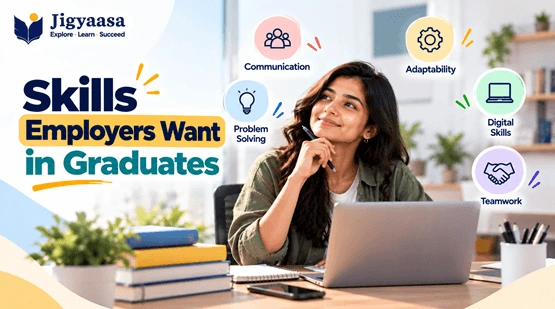
Skills Employers Want in Graduates: A Clever, Practical Guide for 2026
Career skills are very important for students to achieve success in the workplace. Problem-solving techniques with effective communication are the crucial skills employers want in graduates.
Success in the workplace is not just about getting good grades in college. It is expected that students have the ability to apply their knowledge and adjust to new technology.
In this regard, students may need to know how to present their academic activities, internship experience, volunteer work, and leadership experience as important skills.
What Are the Key Skills that Employers Require?
- Data skill: The ability to process and interpret data.
- AI knowledge: Knowing how to make good use of AI technologies.
- Project management: The ability to meet deadlines and cooperate with other people in a team.
- Communication: The ability to convey the same messages to various audiences ranging from technical to non-technical people.
- Emotional intelligence: The ability to adapt to various situations, to work as a member of a team, and to show confidence and resilience.
When preparing for an interview or writing the CV, follow the Asset → Impact → Role scheme:
- Asset: What skill do you possess?
- Impact: What have you done using this skill?
- Role: How can skills be applied in the company?
Skills employers want in graduates: Hard + Soft skills overview
Recruiters today look for students who can do the job in the best way. Building both technical and personnel skills can make students job-ready with a good salary package.
- Build Hard Skills
These are the technical abilities described by professions.
- Python, Excel, SQL, or financial modelling
- Data analysis and statistics
- Industry-specific software
- Regulatory or technical knowledge
These are basic technical skills required for a technical job.
2. Develop soft skills
Soft skills are the personality traits of students. These abilities are necessary for students to develop to achieve higher designations or leadership roles. Technical abilities are good to get a job at entry level; however, for promotions, the combination of technical and soft abilities works well.
- Communication
- Teamwork
- Leadership
- Problem-solving
- Active listening
- Conflict management
- Adaptability
3. Focus on 3 important skills for 2026
These are the 3 main skill requirements for 2026:
- Digital and AI skills: learn relevant AI tools, automation platforms and digital workflows.
- Data Abilities: Learn how to understand data, identify patterns, and use evidence to make decisions.
- Adaptability: students must be adaptable to the new tools, new work style, and their colleagues.
4. List the skills in a descriptive way, with proper categories
Students write their abilities as “Good at data analysis”, but they need to write as “ analysed 1,000 survey responses and presented three valuable findings.
5. Use STAR in Interviews
Students and working professionals can explain their abilities in STAR format.
Situation → Task → Action → Result
For example, a tough college project can have challenges. Tell the interviewer about your contribution and leadership skills used in this project.
At this point, students can explain their technical abilities, practice communication, and gain real experience.
Skills Employers Want in Graduates: Skills by Career Path; A Quick Guide for Students
Various occupations require different IT and technical skills, but at the same time, communication and teamwork, as well as adaptability, are essential qualities crucial for the success of almost any employee.
1. Technical graduates: MCA, BCA, and Engineering graduates
Students aspiring to IT and software occupations need to develop the following abilities:
- Programming: Python, JavaScript, Java, or C++
- Web Development: React, Node.js, and modern frameworks
- Cloud and DevOps: AWS, Azure, or Google Cloud
- Databases: SQL, MySQL, PostgreSQL, or MongoDB
- AI and ML: Python, TensorFlow, or PyTorch
- Team Abilities: Git, code reviews, and Agile development
A tip: Produce 2-3 projects while studying and have them placed on GitHub.
2. Business graduates: MBA, BBA, and Commerce graduates
Graduates of MBA programs have to acquire the following abilities:
Data Analysis:
- Excel, Power BI, Tableau, or Python
- Finance: Financial modelling and budgeting
- Marketing: Market research and digital marketing
- Product Management: Product strategy and customer analytics
- CRM: Salesforce or SAP
- Soft Skills: Negotiation, leadership, and solving problems in various situations.
Tip: Students must work on business case studies and internships to gain practical experience.
3. Jobs in the Public Sector and Government
For jobs in the public sector and government, concentrate on:
- Policies and Regulations: You have to understand policies and regulations.
- Data Analysis: You need to analyse the public programs with data.
- E-Governance: You need to know about online government services.
- Finance: You must know about budgeting and auditing.
- Communication: You have to deal with public communication properly.
- Ethics: You should obey the rules, be transparent, and be accountable.
A simple rule to follow is to select the abilities needed for the target career, practice them in projects or internships, and continuously update your knowledge.
Indian Online Universities And Mapping For Top 5 Career Skills (Technical)
|
Professional Career |
Online Universities |
Degree Available |
Key academic focus |
|
AI/ML |
Amity University online, BITS Pilani (WILP) |
BS/B.Sc. in Data Science, Online MCA (AI specialisation) B.Tech./M.Tech |
Deep learning framework, neural network, Python, and system automation |
|
Data Scientist |
Online Manipal (MAHE), Jain University Online, Chandigarh University Online |
Online M.Sc. in Data Science, online MCA (Data Analytics), Online MBA (Business Analytics) |
Predictive modeling, SQL database, big data systems, and Tableau |
|
Nurse Practitioner |
Hybrid mode |
Requires physical BSN/MSN |
Medical council regulations demand physical, in-person hospital clinical residency. |
|
Product Manager |
NMIMS Global |
Executive PG Certification |
Agile development frameworks, sprint planning, product lifecycles, and UX strategy |
|
Cybersecurity Expert |
LPU online, Amity University online, Symbiosis online (SSODL) |
Online MCA (Cybersecurity), Online BCA (Information Security), M.Sc. in Computer Science |
Ethical hacking methodologies, network cryptography, risk compliance, and cloud security |
5 Essential Skills Employers Want in Job Seekers
When hiring new employees, recruiters focus on more than just their grades. They want candidates who can communicate well, think critically, cooperate with colleagues, adapt to new conditions, and take responsibility.
To impress the employer, students should pay attention to these abilities and include real examples in their resume and cover letter.
1. Communication
Make sure your point comes across clearly both in spoken and written forms.
Example: Give a presentation on a project done in college, or write attractive reports.
2. Problem Solving
analyse the cause of a problem and create a solution.
Example: Describe how you fixed a technical error or developed an interesting improvement.
3. Teamwork
Interact effectively with other people in order to achieve a common goal.
Example: Give information about the projects you have done together, college events, or competitions you participated in.
4. Adaptability
Be ready to learn and use the new tools, technologies, and procedures.
Example: Provide information on how you acquired new software knowledge or adapted to a new situation.
5. Initiative
Act without waiting for anybody to tell you what you have to do.
Example: Describe an event, decision, or project that you initiated personally.
Advice
Do not simply state “Strong communication,” but rather talk about the whole project leading from beginning to end.
What Skills Are Employers Looking For?
The Mismatch between What Is Expected and What Is Obtained
Recruiters label the disparity between what businesses require and the qualifications that graduates possess as the “Credential Illusion.”
Graduates tend to present academic qualifications, while companies are looking for practical on-the-job experience.
- What Graduates Show: High GPAs, academic courses with vague titles, redundant lists of skills such as hardworking and fast learner, and limited participation in extracurricular activities at the university.
- What Employers Are Looking For: Evidence of working under stress, command of industry-specific software, ability to collaborate in teams, and solving ambiguous tasks without a manual.
- The Reality is that having high grades in a course in database management does not mean the ability to restore a crashed database in the early hours of the morning. Employers are searching for practical ability, not simply theory.
Linking skill to Job Descriptions and Principles
To pass the initial Applicant Tracking System and human filters, you should replicate the style of the organisation.
1. Interpreting Job Description
Do not send a perfect resume in general. analyse the job description to discover the requirements of the job:
- If a vacancy states, Should be ready to work in unstructured conditions: The required skill is mastering complexity. Describe how you created a scheme from scratch.
- If a vacancy states: Searching for a self-starter who does not need much supervision: The required skill is initiative. Tell about a project that you carried out independently.
2. Incorporating the Principles of the Organisation
Organisations pay attention to the values of an organisation. Search for the information that can tell about the values of the organisation:
- Innovation-oriented organisations (for example, technology companies): Speak about innovative projects, conducting experiments, and making mistakes.
- Principled-oriented organisations (for instance, banking): Write about risk reduction, accuracy, following procedures, and system audit.
3. Put the Spotlight on Transferable Abilities
If students do not possess an exact piece of technical equipment, draw attention to the general abilities, such as organisational strengths or problem-solving skills:
• Example: “Applied sophisticated skills in harmonizing interests of stakeholders, learned during student government term, to effectively manage a freelance project for a small group of web designers. As a result, the project was completed five days earlier than planned.
Skills Employers Want in Graduates: 30-Day Job Readiness Sprint
These skills help students build job-ready skills in 30 days. These abilities employers want in graduates to complete the projects within deadlines.
Students must audit their abilities, optimise their CV, and earn certificates for better job opportunities.
FAQs
- What skills do employers want in graduates?
Communication, problem-solving, teamwork, digital skills, and adaptability are the most valued skills for employment. Recruiters prefer graduates with technical skills as well as these skills.
- Why are communication skills important?
These skills help students explain ideas with clear objectives. Graduates with these skills also set themselves up as good team members or leaders.
- How can graduates improve their skills?
Take short courses, complete projects, and practice hands-on skills. This way, graduates can increase their technical and soft skills together to grab better job opportunities.
- How should graduates show their skills?
For technical skills learning, get certificates and practice on real projects, then show them in portfolios. For soft skills improvement, join communication classes, participate in formal debates, and dress up properly.