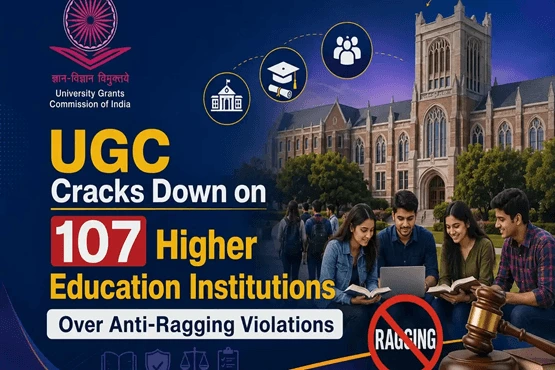
Taking a zero-tolerance approach toward campus harassment, the University Grants Commission (UGC) has issued formal show-cause notices to 107 higher educational institutions across India. The list of defaulters includes 18 medical colleges that have stringently violated the statutory UGC anti-ragging regulations.
The official disclosure was made in Parliament by the Union Minister of State for Education, Sukanta Majumdar, in a written response to queries raised by MP Sayani Ghosh regarding student safety and college ragging cases.
Critical Lapses: Why the UGC Issued Show-Cause Notices
The Ministry of Education revealed that the targeted universities and colleges failed to comply with the mandatory provisions of the Anti-Ragging Regulations, 2009. The primary administrative lapses include:
- Missing Digital Undertakings: Failure to collect mandatory online anti-ragging affidavits directly from enrolled students and parents.
- Non-Submission of Compliance Reports: Total failure to upload annual safety and institutional compliance data to the central monitoring system.
- Defiance of Warnings: Completely ignoring consecutive bi-annual safety advisories and regulatory alerts issued by the UGC.
Data Explodes: Ragging Complaints in India Double Over 4 Years
The regulatory crackdown coincides with a steep rise in reported incidents of campus bullying. Data presented in the Lok Sabha shows that ragging complaints in India have more than doubled over four years.
| Year | Nationwide Ragging Complaints Registered |
| 2022 | 655 cases |
| 2023 | 962 cases |
| 2024 | 1,084 cases |
| 2025 | 1,369 cases |
| 2026 (Up to July 22) | 755 cases |
State-Wise Breakdown of 2026 Cases
The official report highlighted specific regional hotspots for campus harassment:
- Uttar Pradesh: Led the nation with 135 complaints registered so far in 2026.
- West Bengal: Positioned second with 75 complaints.
- Madhya Pradesh: Documented 63 complaints.
- Maharashtra & Bihar: Reported 53 and 50 complaints, respectively.
The Ministry clarified that the data surge is heavily driven by greater student awareness and simplified digital reporting systems, rather than just an isolated rise in campus violence.
Strict Penalties: Funding Freeze and De-recognition
While the Ministry of Education stated its current stance remains corrective, the defaulting institutions face catastrophic penalties if they fail to rectify administrative loopholes within 30 days. Non-compliant campuses risk:
- Funding Freeze: Immediate withdrawal of all financial UGC grants and development funding.
- De-recognition: Loss of official university affiliation or total institutional de-recognition.
- Public Shaming: Public disclosure of the institution’s name on the national list of non-compliant, unsafe campuses.
Punishments for Guilty Students
The UGC has empowered institutional Anti-Ragging Committees to hand down severe punishments to individual student offenders, including:
- Immediate cancellation of admission and academic rustication for up to 4 semesters.
- Debarring from university examinations and withholding academic results.
- Immediate expulsion from college hostels.
- Legal prosecution under criminal law alongside a financial fine of up to INR 25,000.
Mandatory Digital Compliance and Student Support
To streamline safety protocols, the UGC has eliminated physical paperwork.
- Online Affidavit Portal: Students must submit their mandatory anti-ragging declaration exclusively through the Official Anti-Ragging India Portal. Institutions are strictly banned from collecting physical paper affidavits.
- Emergency Helpline: Students facing any form of harassment can instantly contact the 24×7 National Anti-Ragging Helpline Number (1800-180-5522) or email helpline@antiragging.in to log an anonymous complaint.
UGC issued show-cause notices because the institutions failed to comply with mandatory anti-ragging regulations and reporting requirements.
UGC may take regulatory action, including seeking explanations, monitoring compliance, and imposing penalties as per the Anti-Ragging Regulations.
The regulations aim to prevent ragging, ensure student safety, and create a secure and respectful environment in higher education institutions.